SaaS Development Roadmap: From Idea to Launch
Comprehensive framework for building SaaS products, covering ideation, validation, development, and go-to-market strategies.
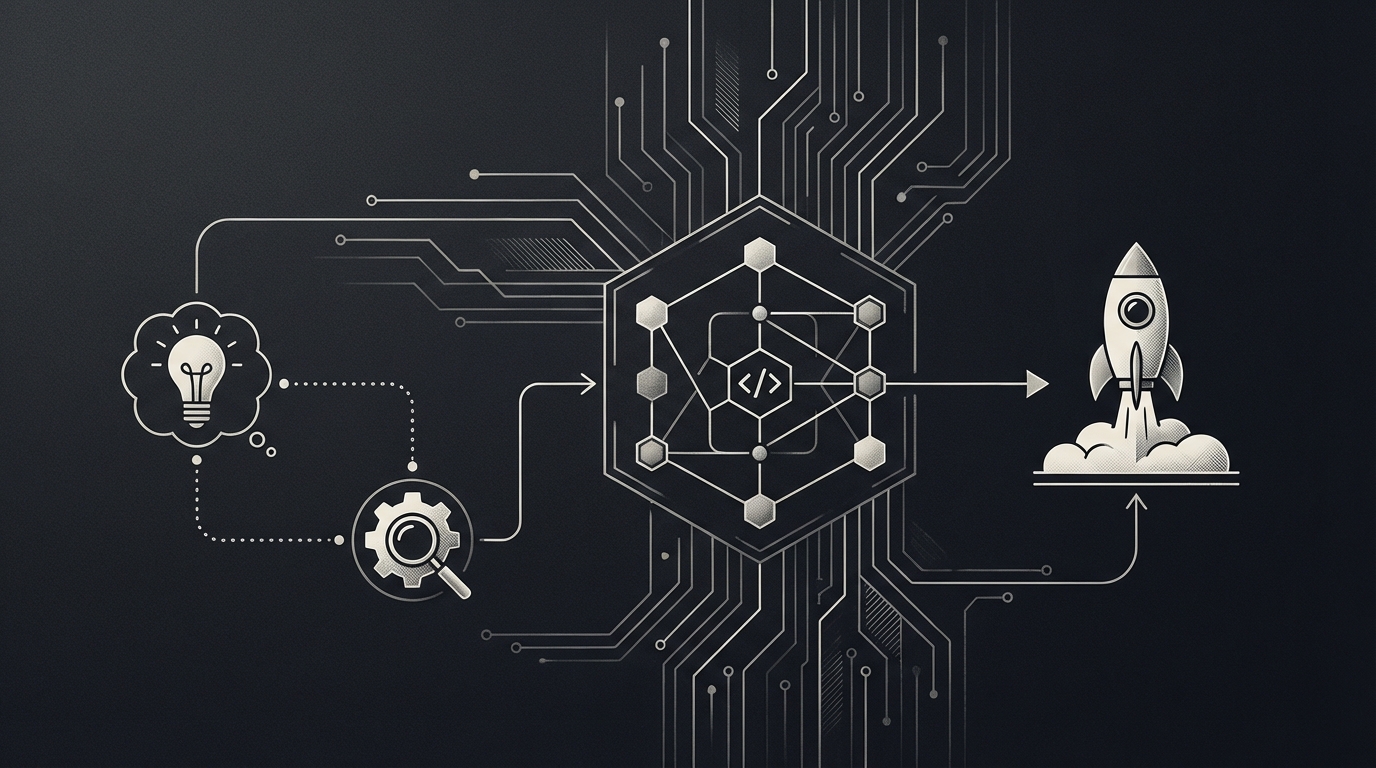
The Complete SaaS Development Roadmap: From Idea to Launch
Building a SaaS product is one of the most rewarding — and challenging — journeys a developer or entrepreneur can undertake. Whether you're a solo developer with a weekend idea or an AI engineer looking to productize an automation workflow, the path from concept to a paying customer base is riddled with decisions that can make or break your product.
The good news? There's a proven framework for navigating it.
In this post, we'll walk through the complete SaaS development roadmap — from problem discovery and market validation all the way through product architecture and go-to-market execution. This is the structured approach that separates products that quietly die at launch from the ones that grow into sustainable, scalable businesses.
Phase 1: Idea, Discovery, and Validation
Every successful SaaS product starts not with a solution, but with a problem worth solving.
Problem Discovery
Before you write a single line of code, you need to answer one question: Who is suffering, and from what? This is the foundation of your entire product strategy.
Effective problem discovery involves:
- Pain point mapping — Identify specific, recurring frustrations in a target audience's workflow. Tools like Reddit, Indie Hackers, Product Hunt discussions, and even LinkedIn comments are goldmines.
- Problem interviews — Structured conversations with potential users. The goal isn't to pitch your idea; it's to deeply understand their world. Ask open-ended questions like "Walk me through how you handle [task] today" rather than "Would you use a tool that does X?"
- Signal tracking — Monitor search volume spikes, trending GitHub issues, or growing communities around an unmet need.
For example, an AI engineer might notice that teams spend hours manually formatting LLM outputs into structured reports. That's a real, specific pain. That's a signal.
Market Research and Niche Selection
Once you've identified a problem, you need to understand the landscape. This means:
- Estimating your Total Addressable Market (TAM) and drilling into the serviceable, realistic slice of it
- Identifying your ideal customer profile (ICP) — not "small businesses," but "two-person SaaS teams using Notion and Slack who ship features weekly"
- Running competitor analysis to map what exists, where it falls short, and where the gap is
The most powerful positioning often comes from going narrower than you think is wise. Serving a specific niche deeply — say, AI-powered documentation tools for open-source maintainers — gives you a focused audience, easier marketing, and higher conversion rates.
Opportunity Mapping and Early Validation
Before building, validate the assumption that people will pay for a solution. This is where many developers skip ahead and regret it.
Key validation tactics include:
Validation Checklist:
✅ 5–10 problem interviews completed
✅ Identified 3+ competitors (proving the market exists)
✅ Built a landing page with a waitlist or pre-order CTA
✅ At least 2–3 people said "I'd pay for this"
✅ Defined your core value proposition in one sentence
A simple landing page with a clear headline and an email signup is often enough to validate direction. Tools like Carrd, Framer, or even a Notion page can serve as your MVP landing page. If you're building AI automation tooling, even a no-code Zapier or Make.com flow can simulate your core workflow before any real engineering begins.
Phase 2: Product Architecture and Development
With validation in hand, it's time to build — but build strategically.
Defining Your MVP Scope
The temptation is to build everything. Resist it. Your Minimum Viable Product should do exactly one thing exceptionally well.
Map your features into three tiers:
| Tier | Description | Include in MVP? | |------|-------------|-----------------| | Core | The single job your product does | ✅ Yes | | Supporting | Features that enable the core job | ✅ Maybe | | Nice-to-have | Bells and whistles | ❌ Post-launch |
For a developer building an AI SaaS product, this might look like:
- Core: Automated code review via LLM with GitHub integration
- Supporting: Configurable rule sets, Slack notifications
- Nice-to-have: Team dashboards, analytics, multi-repo support
Tech Stack Decisions
For modern SaaS products targeting developers and automation-savvy users, a lean, scalable stack matters. Here's a practical starting point:
Frontend:   Next.js + Tailwind CSS
Backend:    Node.js (Express) or Python (FastAPI)
Database:   PostgreSQL + Prisma ORM
Auth:       Clerk or Supabase Auth
Payments:   Stripe (with Stripe Billing for subscriptions)
AI Layer:   OpenAI API / Anthropic Claude API
Hosting:    Vercel (frontend) + Railway or Render (backend)
If you're building AI-native automation tools — which is increasingly the default for modern SaaS — consider designing your architecture with agent-friendly APIs from day one. Think streaming responses, webhook support, and structured JSON outputs that other tools can consume easily.
The Build Loop
Development should follow a tight feedback loop:
- Build a feature
- Get it in front of 2–3 beta users immediately
- Collect qualitative feedback (record sessions with tools like Hotjar or FullStory)
- Iterate or cut before moving on
Avoid "building in the dark" for months. Ship early, ship often, and treat your first 10 users as co-creators, not test subjects.
Phase 3: Go-to-Market and Growth
Launching a SaaS product isn't a single event — it's a process. Your go-to-market (GTM) strategy should begin the moment you start building.
Pre-Launch Momentum
Use your build period to generate anticipation:
- Build in public on X/Twitter, sharing weekly progress updates, early screenshots, and lessons learned. This is one of the highest-ROI distribution strategies for developer-focused tools.
- Grow a waitlist — Even 200–300 genuinely interested subscribers is a powerful launch asset.
- Engage your niche communities — Be genuinely helpful in Slack groups, Discord servers, and subreddits relevant to your ICP. Not promotional. Helpful.
Pricing Strategy
SaaS pricing is both an art and a science. For most early-stage products:
- Start with a freemium or free trial model to reduce friction and gather users
- Structure paid plans around value metrics (e.g., number of API calls, seats, documents processed) rather than arbitrary feature gates
- Use annual billing discounts (typically 20% off) to improve cash flow and reduce churn
Example Pricing Tiers:
🆓 Free:       5 AI runs/month, 1 user, community support
💼 Pro ($29):  Unlimited runs, 3 users, email support
🏢 Team ($99): Unlimited runs, 10 users, priority support, API access
Launch and Iteration
When you're ready to launch publicly:
- Post on Product Hunt (prepare assets 2 weeks ahead)
- Submit to relevant directories (there are hundreds of SaaS and AI tool directories)
- Reach out personally to your waitlist — a personal email converts far better than a broadcast
After launch, shift your focus to retention over acquisition. Track your monthly churn, talk to churned users, and double down on what's working. The roadmap never ends — it evolves.
Conclusion
The SaaS development roadmap isn't a linear checklist — it's a living framework that adapts as you learn. The developers and AI engineers who succeed aren't the ones with the most sophisticated tech stacks or the biggest ideas. They're the ones who talk to users relentlessly, ship fast, and iterate with discipline.
Whether you're building an AI automation tool, a developer utility, or the next B2B productivity platform, the phases are the same: discover a real problem, validate before building, develop with focus, and go to market early and often.
Start with the problem. Everything else follows.
Source
This post was inspired by a comprehensive SaaS development framework shared by @hridoyreh on X/Twitter. Check out the original thread for the full directory-style breakdown of the SaaS building lifecycle.
Tags
Related Skills
Amazon Market Research
Generate comprehensive Amazon market research reports from product name, target market, and sales platform.
Data Model
Complete data modeling workflow for analytics and warehouse design covering grain, dimensions, facts, keys, and SCD strategies.
Browser Use Agent SDK
Open-source SDK for building browser automation agents with multi-LLM support
Related Articles
From Data Sales to SaaS: Product Strategy Upgrade
Case study on leveraging AI to transform virtual resource business into SaaS product by targeting underserved niche languages market.
The Real Threat Behind Anthropic's 21 Plugins: Why SaaS Companies Lost $285 Billion
In 25 days, Anthropic launched 21 plugins and triggered a $285B SaaS market wipeout. A former Google PM spent 4 weeks testing them all. His verdict: this isn't a product launch—it's an extinction event.
15 Essential SaaS Tools for Indie Developers
Curated list of 15 tools for indie SaaS development covering AI coding, databases, authentication, email, payments, and deployment.